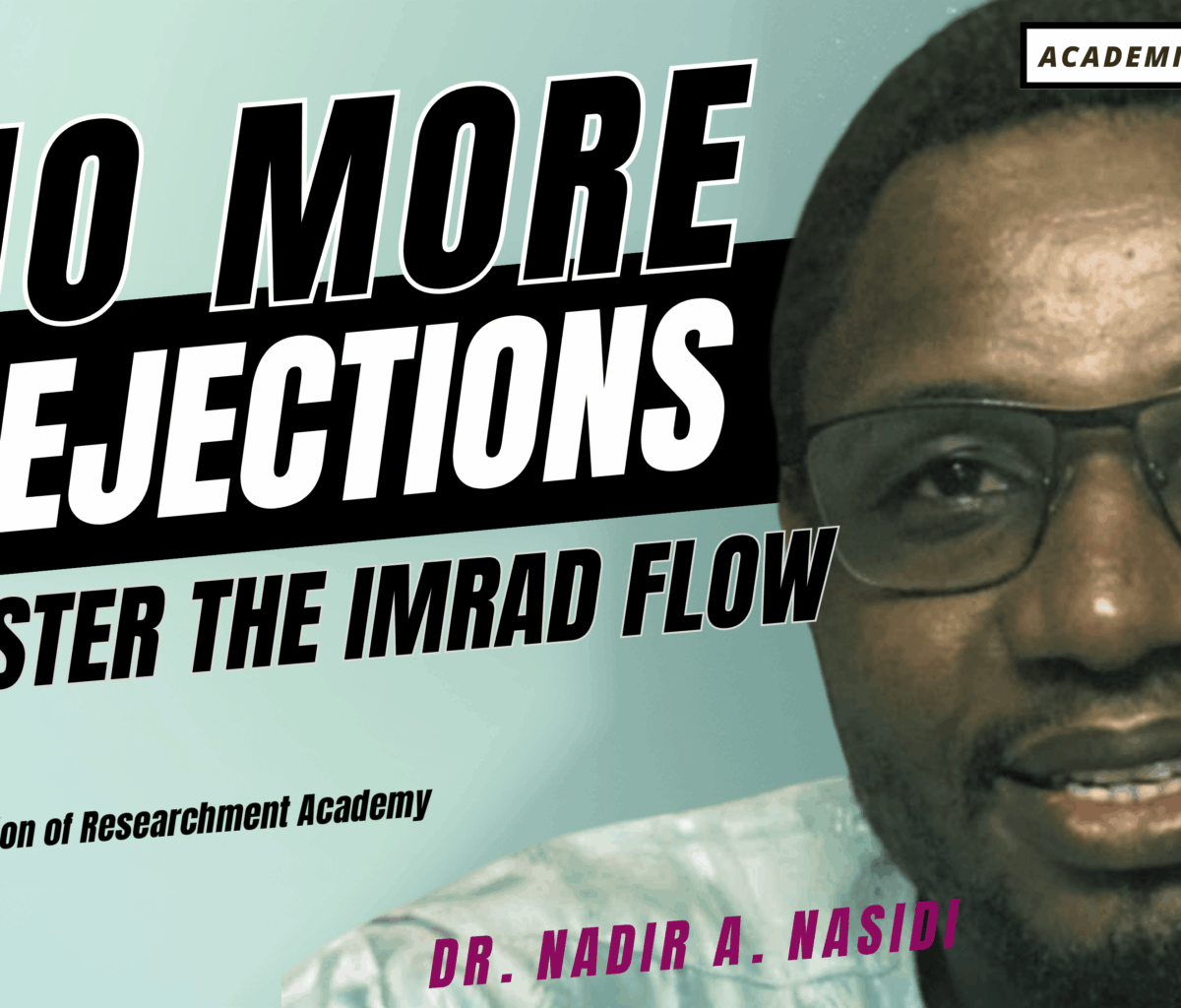
In the competitive world of academia, the mantra “publish or perish” is often cited as a warning to scholars. However, as Dr. Nasidi from Ahmadu Bello University Zaria explained in a recent Researchment Academy webinar, scientific publication is about much more than just career survival. It is the engine of human development and civilization, designed to advance knowledge, fill critical gaps, and establish global credibility.
Yet, even the most groundbreaking research can fail to reach its potential if it is poorly structured. A manuscript with a “rowdy” or illogical architecture is likely to face immediate desk rejection from high-impact journals. To help you navigate this, we’ve put together this extensive guide on optimizing your manuscript architecture using the globally recognized IMRAD format.
What is Manuscript Architecture?
Before diving into the structure, it is essential to understand two core concepts:
-
Manuscript: A draft version of a written work (original research, analysis, or experimentation) prepared for publication.
-
Architecture: The structural organization and design of that manuscript. Just as a building needs a solid blueprint to stand, a paper needs a logical arrangement to have scholarly impact.
The IMRAD Format: The “Golden Standard”
Most scientific and social science journals follow the IMRAD structure. This acronym represents the core flow of a paper:
-
I — Introduction: Why did you start the study?
-
M — Methodology: How did you conduct the study?
-
R — Results: What did you find?
-
A — and — (The conjunction connecting findings to interpretation)
-
D — Discussion: What do the findings mean?
READ ALSO: 3 Ways to Write Impactful Research Introductions | Capture and Maintain Reader Attention

1. The Abstract: Your Research “Window”
The abstract is the most viewed part of any paper. Researchers use it to decide whether the rest of the study is worth their time.
-
What it covers: Central thesis, methodology, key findings, and final conclusions.
-
The 150-300 Rule: Most journals limit abstracts to between 150 and 300 words.
-
Pro Tip: Never write your abstract first. Write the full paper, review it multiple times, and then distill the core essence into the abstract.
Introduction: The Heart of the Case
Dr. Nasidi argues that the introduction is the most important part of the manuscript. Think of yourself as a lawyer defending a client in court—this is where you make your opening statement.
-
Establish the Gap: You must show that you are either debunking an old theory, expanding boundaries with new data, or exploring a “virgin” area that previous studies missed.
-
The “Local to Global” Bridge: If you are studying a local issue (e.g., a specific town in Nigeria), use the introduction to link it to regional or global trends. This makes your work relevant to readers in Europe, Asia, or America.
-
Coherence: The thesis you state in the introduction must be sustained throughout every subheading of the paper. Consistency is key to a logical flow.
Methodology: The Proof of Rigor
The goal of this section is replicability. Another researcher should be able to follow your steps to prove or disprove your findings.
-
Study Design: Clearly state if your research is Qualitative (non-numerical) or Quantitative (numerical/statistical).
-
Justification: Don’t just list your tools (e.g., oral interviews, archives, or surveys). Explain why you chose those specific tools and how you chose your informants.
-
Ethical Considerations: Especially in studies involving human subjects, you must document informed consent, privacy protections, and participants’ right to withdraw.
READ ALSO: 3 Research Crimes That will get your Paper Retracted
Results & Discussion: Reporting vs. Interpretation
There is a frequent debate about whether these should be separate or combined.
-
Results (The Facts): This should be a highly objective report of data. Use tables and charts to condense large amounts of information, and avoid adding personal bias or interpretation here.
-
Discussion (The “So What?”): This is where you interpret the findings. Compare your results with prior studies to highlight “oddities” or “links”.
-
The Multi-Objective Debate: If your study has three objectives, you can either present all results first and then discuss them together, or discuss each result immediately after it is presented. Choose the format that best suits your journal’s guidelines.
References: The Backbone of Credibility
A paper with poor documentation is often discarded immediately by serious publishers.
-
The Consistency Rule: Every source cited in the text must appear in the reference list, and every source in the list must be cited in the text.
-
Use Managers: Dr. Nasidi highly recommends tools like Zotero or Mendeley. They allow you to change citation styles (e.g., from APA to Chicago) in seconds and ensure no source is forgotten.
-
The 5-Year Rule: While “seminal works” (like Aristotle or early pioneers) are important, about 70% of your sources should be recent—ideally from the last 2 to 5 years—to show you are up-to-date with current trends.
Style Tips for High Impact
-
Active vs. Passive Voice: Always prefer the active voice. It is more direct and less ambiguous.
-
Passive: “The essay was written by the student.”
-
Active: “The student wrote the essay.“
-
Maintain Objectivity: Detach yourself from the research. Avoid allowing personal religious, ethnic, or political biases to drive your analysis. Let the data speak for itself.
-
-
Patience is a Virtue: Writing a high-quality scientific paper is not a sprint. Data collection can take months, and the writing and review process can easily take up to a year.
READ ALSO: How to Write Scientific Paper Titles That Get Cited (PICO & KISS Framework)
Tools to Optimize Your Architecture
-
Grammar & Style: Use Grammarly or Hemingway Editor to clean up linguistic errors, especially if English is your second language.
-
Plagiarism Check: Use Turnitin to check your similarity index before submission.
-
Internal Peer Review: Before sending your work to a journal, share it with mentors or senior colleagues. This drastically reduces the rate of rejection from international journals.
By following the IMRAD structure and focusing on logical coherence, you transform your research from a simple document into a powerful contribution to the global scientific community. Remember, a well-structured paper doesn’t just get published—it gets cited.
Ready to get published? Revisit your current manuscript title today. Does it follow the Law of Context? Is it hitting the KISS sweet spot? A few small tweaks could be the difference between 20 views and 25,000.
Stay Connected & Informed: Want to be the first to know about our upcoming research events and exclusive webinar updates? Follow Researchment on Facebook, LinkedIn and Instagram.

Unlock Future Opportunities: Ready to elevate your research journey with more insightful sessions like this one? Visit academy.researchment.com to register for upcoming webinars. Our Researchment Academy series is packed with knowledge to empower you!
Ready to Elevate Your Research? Publish with Glintplus!
Stop waiting and start making an impact. Submit your manuscript to one of our esteemed journals at glintplus.com/journals and become part of a thriving community of researchers who trust Glintplus for:
- Unwavering Quality: Rigorous peer review and high editorial standards.
- Maximum Visibility: Broad indexing and effective dissemination of your work.
- Academic Integrity: Ethical publishing practices you can rely on.
Take the Next Step in Your Publication Journey:
 Ready to Submit? Visit glintplus.com/journals to explore our journals and streamline your submission process.
Need a Manuscript Makeover? Our expert editorial support and comprehensive author resources are here to help you shine. Contact us today via publish@glintplus.com!
Never Miss an Opportunity! Stay ahead of the curve by following Glintplus on Facebook, LinkedIn and Instagram for the latest updates and publishing tips.
Let’s collaborate to amplify your groundbreaking research and ensure it reaches the global audience it deserves.