In the high-stakes world of research, a brilliant idea is no longer a guarantee to secure research funding. With acceptance rates for major national and international grants often hovering in the single digits, the gap between “fundable” and “funded” is widening.
Securing research funding is highly competitive, and success often depends not just on the brilliance of your idea, but on your strategic approach to proposal development.
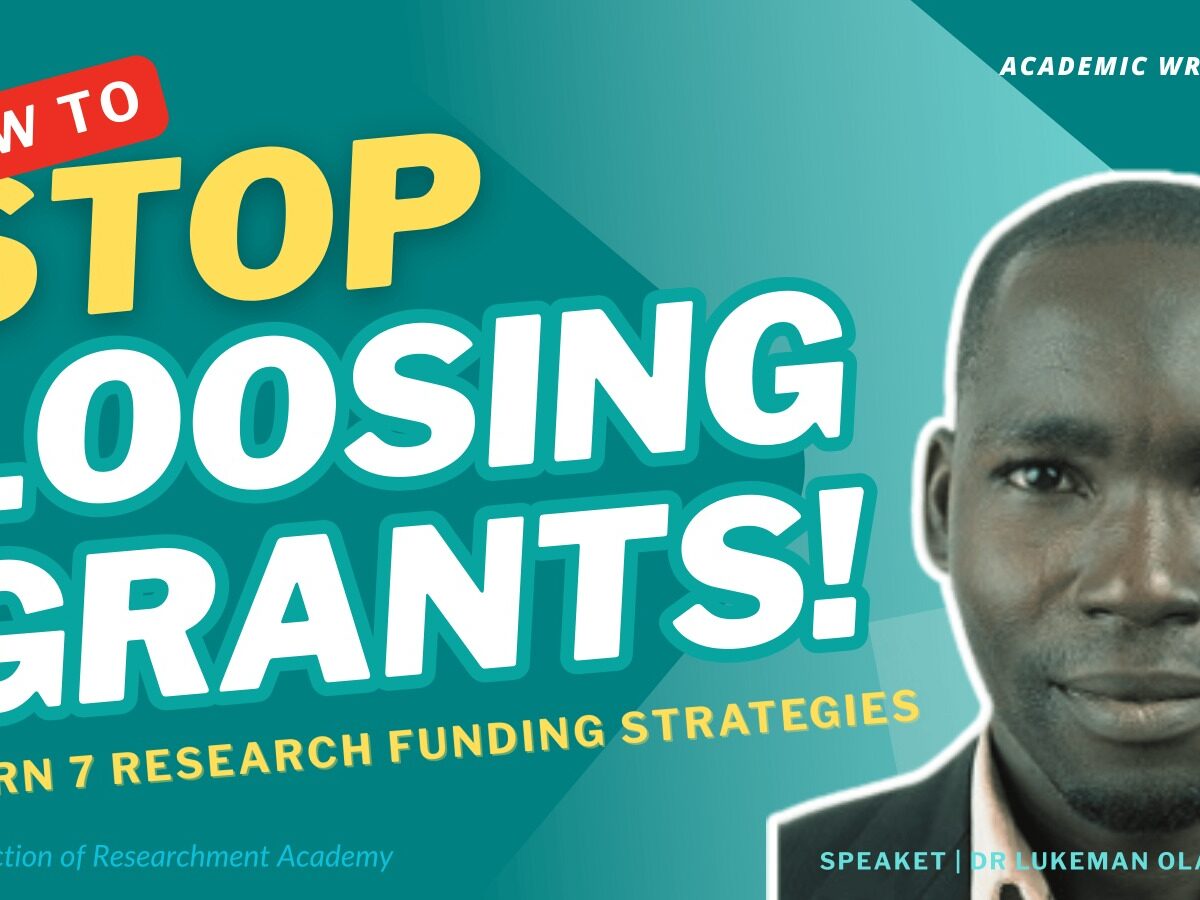
As noted in expert discussions on research funding lead by Dr. Olasunkami, “The need to be strategic in grant proposal is for the fact that when you are strategic in developing your funding proposal it will increase the chances of securing fund.”
A winning proposal is one that is compelling, focused, and, most critically, aligns perfectly with the sponsor’s mission and objectives.
7 Strategies to Secure Research Funding
This post outlines seven essential strategies to develop funding proposals that magnetize funders and secure the resources you need.

-
Strategic Alignment is Non-Negotiable
Research funding is vital; it drives innovation, facilitates collaboration, empowers your career, and allows you to acquire the necessary infrastructure (equipment, chemicals, etc.) to pursue new knowledge.
To succeed in this competitive environment, you must be strategic:
- Increase Your Chances: A strategic proposal significantly increases the likelihood of securing the fund.
- Convey Viability: Funders want to know their money is a sound investment. Your proposal must convey project viability, demonstrating that your team has the expertise and experience to complete the work and sustain its impact beyond the funding period.
- Be Compelling: You must be able to persuade the funder that your research is highly compelling and directly serves their mission and priorities.
-
Research the Funder
Before you draft a single sentence of your project plan, you must deeply understand the entity providing the funds.
- Identify the Funder’s Profile: Determine if the funder is a corporate organization, government agency, or an individual foundation. Study their core missions, goals, and key priorities.
- Analyze Past Successes: Crucially, study previous proposals that have won the grant. This will reveal the types of projects the funder is interested in and what their grant profile looks like. Check their website for lists of past grant recipients.
- Seek Clarification: Never assume. If any part of the call or template is unclear, seek further clarification from the funder to ensure your project fits the criteria.
- Monitor Calls: Be familiar with funding agencies and monitor their websites, as calls for proposals are often released at specific times of the year.
READ ALSO: Writing for High-Impact Journals: Unlock the Secrets to Clarity, Rigour & Publication Success
-
Aligning Your Project Aims (The “How-To”)
The core of a strategic proposal is ensuring your project’s goals are perfectly aligned with the funder’s objectives. Your project goal must seamlessly key into the funder’s objective. This alignment can take several forms:
| Funder Priority | Your Project Alignment Strategy |
| Geographic Location | Ensure your research is explicitly centered on the region of interest to the funder. |
| Sustainable Development Goals (SDGs) | Your proposal must demonstrate how it addresses a particular SDG the funder is focused on. |
| Capacity Building | If the funder targets training, your proposal must be tailored to organize workshops, seminars, or specific training to align with this priority. |
| Specific Societal Issues | If the funder’s mission is about improving literacy rates, your project must detail how it intends to contribute to that specific outcome. |
-
The SMART Planning Principle
A funder needs assurance that your research is well-designed and executable. Your project plan must adhere to the SMART criteria:
- Specific: Your research methodology and terms must be so specific that the process is reproducible in other parts of the world.
- Measurable: You must have clear ways of measuring or following the progress toward your.
- Achievable: Your methods must be relevant and achievable, ensuring that objective number one aligns with method number one, and so on.
- Relevant: Your objectives must be relevant to the overarching goal of the project.
- Time-bound: Clearly define the time frame for the entire project, ensuring it aligns with the funder’s specified timeline.
Every Objective must have a corresponding Research Question. Every Research Question must have a detailed Methodology. Every Methodology must have a Budget Line Item.
If you list an objective but have no budget for it, the project is not viable. If you have a budget item for a method that answers no objective, it is waste.
-
Build an Unstoppable Team and Viability Case
“Collaboration as a Force Multiplier”. In modern research, the “lone wolf” era is ending. Reviewers view collaboration as a risk-mitigation strategy. Here are two things to consider;
- Complementary Skills: Don’t just add names to pad the list. If you are a chemist synthesizing a drug, partner with a clinician who can test it, or a statistician who can analyze the data.
- Expert Insight: “Catching the funders interest requires that you demonstrate collaboration prospects. You don’t just sit in your own corner and claim that I will be the only one to do all the research.”
In addition, you must proving viability & sustainability by convincing the funder that the project is “safe” in your hands.
- Risk Management: Include a “Potential Pitfalls and Contingencies” section. What happens if recruitment is slow? What if the machine breaks? Showing you have a Plan B proves you are a seasoned professional.
- Sustainability: What happens when the grant money runs out? Will the university take over maintenance costs? Will the project generate its own revenue? Funders hate “white elephant” projects that die the moment the grant ends.
-
Master the Proposal Narrative and Structure
The Hook (The Executive Summary) is the most important page of your application. Reviewers are tired and overworked. You must hook them in the first paragraph.
The Formula: Problem + Your Solution + Alignment with Funder + Impact.
Make them care about the problem before you sell them on your solution.
Clearly articulate the “So What?” factor.
- Contribution to Knowledge: How does this move the field forward?
- KPIs (Key Performance Indicators): Use numbers. “This project will result in a 20% reduction in processing time,” or “We will train 5 PhD students.” Tangible impact wins over vague optimism.
A detailed Gantt chart is non-negotiable. It serves as a visual proof of feasibility.
- Granularity: Break the project down by months or quarters.
- Responsibility: Assign initials to tasks (e.g., “Data Cleaning – Postdoc A – Months 1-3”). This shows you have thought about the logistics, not just the science.
-
Developing a Justifiable Budget
Your budget is not just a spreadsheet; it is a narrative description of your project expressed in numbers. For example, If you ask for a $50,000 laser, there must be a clear method in the proposal that requires that laser. If the connection is missing, the budget will be cut, or the proposal rejected.
Budget Categories & Strategy
- Personnel: This is often the largest cost. Justify why you need a senior researcher vs. a junior assistant.
- Consumables & Equipment: Be realistic. Under-budgeting suggests you don’t know the true cost of research; over-budgeting looks greedy.
- Dissemination: Don’t forget to budget for “Open Access” publication fees and conference travel. It shows you are serious about sharing results.
Finally, never leave the reviewer guessing. The “Budget Justification” document is your chance to argue for quality. Explain why you need the expensive reagent (e.g., “higher purity required for sensitive detection”) rather than the cheap generic one.
READ ALSO: Weekly Scholarship Round-Up: Funding for Students & Researchers
Key Elements of a Strategic Proposal Structure
While you must always adhere to the funder’s template if one is provided, a typical strategic grant proposal includes these key sections:
| Proposal Section | Strategic Focus |
| Cover Letter/Concept Note | A brief summary of the project and the total amount requested, without a detailed budget breakdown. |
| Project Title & Abstract | Concise title and a brief executive summary that explicitly expresses the project goals and, crucially, its alignment with the funder’s priority. |
| Introduction/Background | Demonstrate your deep understanding of the field, what the knowledge gap is, and the project’s relevance to the funder’s mission. |
| Goals and Objectives | Ensure your objectives are the clear answers to your research questions. |
| Research Design & Methodology | Methods must be clearly spelled out, reproducible, and explicitly linked to the achievement of each objective. |
| Significance and Innovation | Clearly spell out the impact of your research and its contributions to knowledge. |
| Timeline and Framework | Use a Gantt chart or similar framework. Ensure each part of the timeline addresses a particular objective (e.g., “Objective 1 achieved within the first 3 months”). |
| Budget and Justification | Provide a financial plan with a detailed justification for every item. The budget must have a clear alignment with the project activities. |
| Research Team | Showcase a strong, often interdisciplinary team. If you are a chemist synthesizing a new drug, you should include a member from medicine or microbiology to boost the viability of the project. |
| Sustainability and Risk | Outline a plan for what happens after the funding ends, and include a contingency plan to address potential challenges or obstacles. |
Advice for Grant Seekers
Securing a grant is a journey that often involves setbacks. The speaker offered practical advice for all researchers:
- Don’t Fear Rejection: Many successful researchers have experienced rejection. Do not feel discouraged; rather, refine the same proposal and resubmit it to the same or a different grant.
- Embrace Mentorship: Early career researchers should actively seek mentors who can help them develop their grantsmanship and navigate the research landscape.
- Collaborate Broadly: No discipline should be considered a “dry area” for funding. Develop collaborative, multidisciplinary approaches (e.g., Education and Medicine) to ensure your project is relevant to a wider range of funding opportunities and strengthens your team’s capability.
If you are a young researcher, don’t aim for the multimillion-dollar grant immediately.
- Seed Grants: Apply for smaller internal university grants or “early career” awards.
- Track Record: Successfully managing $10,000 proves you can handle paperwork, deadlines, and deliverables. This “administrative trust” is a prerequisite for winning $1,000,000 later.
Conclusion
Securing research funding is a discipline that can be mastered. It requires you to be a detective during the research phase, a salesperson during the writing phase, and a stoic during the submission phase.
Remember, success is rarely about luck. It is achieved through the disciplined alignment of your passion with the funder’s priorities.
Don’t wait for the “perfect” time to start. Identify your next potential funder today, download their strategic plan, and begin reverse-engineering your path to success.
Developing a strategic funding proposal is about seeing your project through the funder’s lens. By aligning your aims with their priorities, ensuring viability, and presenting a clear, persuasive plan, you significantly increase your chances of securing the research funding you need.
Stay Connected & Informed: Want to be the first to know about our upcoming research events and exclusive webinar updates? Follow Researchment on Facebook, LinkedIn and Instagram.
Unlock Future Opportunities: Ready to elevate your research journey with more insightful sessions like this one? Visit academy.researchment.com to register for upcoming webinars. Our Researchment Academy series is packed with knowledge to empower you!
Ready to Elevate Your Research? Publish with Glintplus!
Stop waiting and start making an impact. Submit your manuscript to one of our esteemed journals at glintplus.com/journals and become part of a thriving community of researchers who trust Glintplus for:
- Unwavering Quality: Rigorous peer review and high editorial standards.
- Maximum Visibility: Broad indexing and effective dissemination of your work.
- Academic Integrity: Ethical publishing practices you can rely on.
Take the Next Step in Your Publication Journey:
 Ready to Submit? Visit glintplus.com/journals to explore our journals and streamline your submission process.
Need a Manuscript Makeover? Our expert editorial support and comprehensive author resources are here to help you shine. Contact us today via publish@glintplus.com!
Never Miss an Opportunity! Stay ahead of the curve by following Glintplus on Facebook, LinkedIn and Instagram for the latest updates and publishing tips.
Let’s collaborate to amplify your groundbreaking research and ensure it reaches the global audience it deserves.